The 66-Seat Gamble: How the Netherlands Stumbled into a Minority Government Nobody Wanted
D66, VVD, and CDA are about to form the first deliberate minority cabinet in Dutch history. The question isn't whether it will work, but how spectacularly it might fail.
There is something almost poetic about the number 66. It's the total seat count of the incoming coalition of D66 (Democrats 66, a progressive-liberal party), VVD (People's Party for Freedom and Democracy, the main centre-right liberal party), and CDA (Christian Democratic Appeal), which is ten short of a majority in the House of Representatives, sixteen short in the Senate, and roughly one hundred percent short of any coherent governing mandate.
Welcome to the Netherlands' most audacious political experiment since the country decided windmills were a sensible form of energy production.
On Monday, January 27th, the three party leaders emerged from their negotiating bunker to announce what everyone already knew: they had reached a deal on the main policy outlines and the all-important "financial framework," the elegant Dutch euphemism for the spreadsheet that determines who gets taxed, who gets subsidised, and who gets rhetorically comforted while neither happens. The coalition agreement will be formally presented this Friday, with the government's swearing-in ceremony optimistically pencilled in for February 23rd.
Rob Jetten, the 37-year-old D66 leader who will almost certainly become the youngest prime minister in Dutch history, emerged from negotiations declaring he has tremendous enthusiasm to get started. One cannot help but wonder if this enthusiasm will survive the first time GroenLinks-PvdA (the merged Green-Left and Labour party, now the largest opposition force) decides to extract its pound of flesh in exchange for not torpedoing the annual budget.
The Art of the Impossible Deal
To understand how the Netherlands ended up with a minority government that nobody explicitly campaigned for, one must appreciate the exquisite geometry of Dutch political obstinacy. The VVD, under Dilan Yeşilgöz, categorically refused to work with GroenLinks-PvdA, citing ideological incompatibility and, one suspects, a deep-seated unwillingness to sit across a table from Jesse Klaver (the GroenLinks-PvdA leader) more than absolutely necessary. D66, in turn, refused to bring JA21 (a right-wing populist party that split from the Forum for Democracy) into the coalition, arguing that the party's positions on migration and Europe were incompatible with D66's vision of a progressive Netherlands connected to the European project.
This left exactly one option: the three-party minority government that none of them actually wanted. CDA leader Henri Bontenbal, displaying the kind of pragmatism that has kept his party relevant despite decades of ideological drift, called it "a new political reality" and expressed hope for "a new political culture." One imagines this new culture will involve a lot of late-night phone calls and hurried corridor negotiations, but perhaps that's what passes for renewal in The Hague these days.
The Numbers That Haunt the Binnenhof
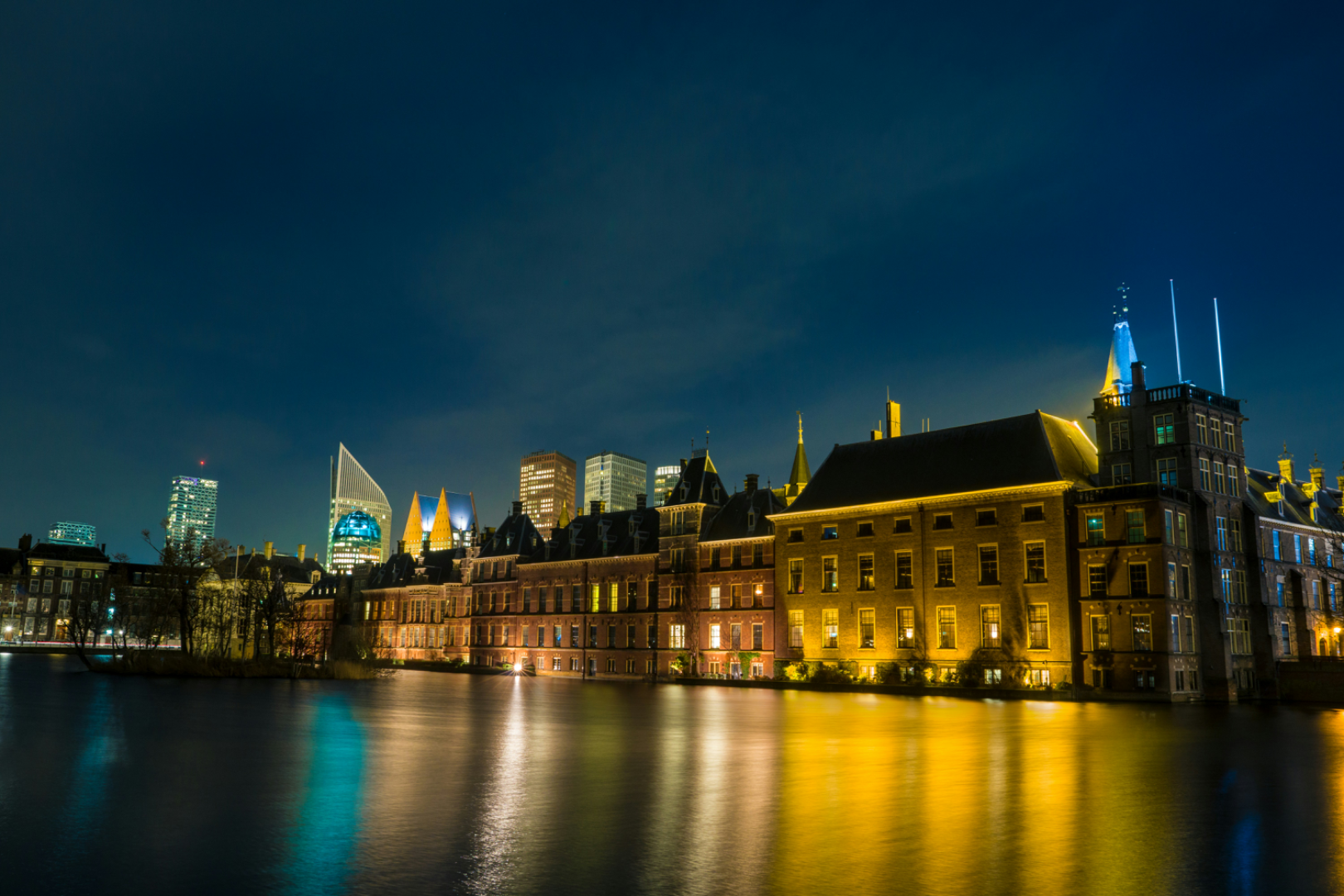
The Binnenhof is the historic complex in The Hague that houses the Dutch parliament and prime minister's office, the equivalent of Westminster or Capitol Hill.
- Coalition seats (House): 66 of 150 (44%)
- Coalition seats (Senate): 34 of 75 (45%)
- Seats needed for majority: +10 House, +16 Senate
- GroenLinks-PvdA seats: 20 (enough to deliver majority alone)
- JA21 seats: 9 (enough for near-majority at 75)
- Projected swearing-in: February 23, 2026
- Days since election: ~121 (one of fastest formations in decades)
The Yeşilgöz Question: In or Out?
Perhaps no figure embodies the contradictions of this formation more than VVD leader Dilan Yeşilgöz. Having spent the past year positioning herself as the tough-talking conservative alternative to the PVV (Party for Freedom, Geert Wilders' far-right party), she now finds herself in the uncomfortable position of being the coalition partner that everyone would rather not have to deal with.
The whispers from D66 and CDA sources are remarkably consistent, and remarkably brutal. "A minority coalition needs likability," one CDA insider told reporters. "Dilan doesn't have it." At D66, the sentiment is even more pointed: "With her as parliamentary group leader, cooperation with the left will be extremely difficult. So let her go into the government." The subtext is unmistakable: please remove this woman from any position where we have to negotiate with her directly.
Yeşilgöz herself has been coy about her intentions, telling Dutch television that she "hasn't decided yet" whether she wants to become deputy prime minister and minister. This indecision is unusual for someone who has never been accused of lacking ambition. Those who have followed her career suggest the hesitation may be tactical: a ministerial post would remove her from the daily parliamentary combat she clearly relishes, while a parliamentary group leadership role would keep her relevant but potentially make the coalition's relationship with GroenLinks-PvdA unworkable.
🔥 The Crown Princes Waiting in the Wings
If Yeşilgöz does enter the government, the question of VVD parliamentary leadership becomes immediate. Two names dominate the speculation: Ruben Brekelmans, the current Defence Minister who has built a reputation as a competent technocrat with decent media presence, and Eelco Heinen, the Finance Minister who occupies the number-two spot on the party list. Both are seen as more conciliatory figures who might smooth relations with coalition partners and opposition alike. The irony that Yeşilgöz might be "promoted" out of a role her allies desperately want her to vacate is not lost on anyone in The Hague.
Bontenbal's Calculated Humility
In contrast to Yeşilgöz's strategic ambiguity, CDA leader Henri Bontenbal has been refreshingly clear: he intends to remain parliamentary group leader in the House of Representatives. This decision, while seemingly modest, is actually quite shrewd. A minority government's survival depends almost entirely on its ability to negotiate with opposition parties bill by bill, budget by budget. Having the party leader in the House rather than in a ministry means Bontenbal can personally manage the delicate relationships that will determine whether this government lasts four years or four months.
There is also the matter of CDA's remarkable resurrection to consider. The party went from a catastrophic 5 seats in 2023 to 18 seats in 2025, a recovery that owes much to Bontenbal's earnest, somewhat nerdy appeal as the physicist who speaks in complete sentences and appears to actually believe in things. Disappearing into a ministry would risk squandering this political capital.
The Financial Puzzle and Its Missing Pieces
The coalition agreement, to be released Friday, reportedly contains what the negotiators call "enormous investments" in defence, hardly surprising given Mark Rutte's recent lecture to the European Parliament about NATO spending, and commitments to housing construction and economic innovation. The details of the financial framework have been the subject of intense weekend negotiations, with all three party leaders looking visibly exhausted by Monday evening.
What remains conspicuously unclear is how a government without a parliamentary majority intends to pass the necessary legislation. The optimistic theory, borrowed from Scandinavian practice, is that different majorities can be assembled for different issues: left-leaning parties for climate policy, right-leaning parties for migration, and some combination thereof for economic matters. The pessimistic theory, voiced most clearly by Geert Wilders (the PVV leader who has been excluded from all coalition talks), is that "there will be new elections next year."
"If anyone thinks this minority government will survive its first serious crisis, keep on dreaming. You can't."
The Opposition's Dilemma
The most fascinating dynamics will emerge not within the coalition, but in its relationship with the opposition. GroenLinks-PvdA leader Jesse Klaver initially called the minority government "a risky political experiment" and a "crucial mistake." But in a notable shift at his party's new year reception, he announced a willingness to negotiate "deals" with the incoming government, provided they do not "further dismantle the welfare state."
The strategic calculus for Klaver is delicate. If GroenLinks-PvdA plays purely obstructionist opposition, they risk being blamed for governmental chaos and may actually strengthen the position of the coalition parties. But if they cooperate too readily, they become de facto supporters of a government their voters did not choose, potentially losing credibility as an opposition force. The party has signalled interest in agreements on nitrogen emissions policy, the so-called "stikstof" crisis, a uniquely Dutch problem where court rulings have blocked construction and farming due to excessive nitrogen deposition in protected nature areas. They have also expressed interest in housing construction and social security, precisely the areas where the coalition may need their twenty seats most desperately.
The smaller parties face similar calculations. The SGP's (a small orthodox Protestant party) Chris Stoffer has indicated willingness to support "neutral proposals" like road maintenance, while drawing lines on medical-ethical issues. JA21's Joost Eerdmans, still bitter about being excluded from coalition negotiations, must decide whether to be a constructive partner who might gain influence or a permanent critic who might gain voters. Even 50Plus (a pensioners' rights party) with its modest two seats, could prove decisive in close votes.
Timeline: The Road to the Palace Steps
In Dutch tradition, new governments are sworn in by the King at the Noordeinde Palace, with the iconic photo taken on the palace steps ("bordes").
- Oct 29, 2025: Elections; D66 and PVV tie at 26 seats
- Nov 4: Wouter Koolmees (D66) appointed as "verkenner"
- Nov 13: Hans Wijers resigns after controversial comments
- Dec 2: Sybrand Buma presents D66-CDA policy document
- Dec 10: Rianne Letschert appointed; VVD joins talks
- Jan 9, 2026: Three parties announce minority government intent
- Jan 27: Main policy agreement reached
- Jan 31: Coalition agreement presentation (expected)
- Feb 23: Government swearing-in ceremony (projected)
The Ministerial Speculation Game
With the policy framework nearly complete, attention inevitably turns to personnel. Beyond Jetten as prime minister and the Yeşilgöz question, several names are circulating in The Hague's corridors. Informateur Rianne Letschert, the rector magnificus of Maastricht University who has won praise from all sides for her handling of the negotiations, is reportedly being considered for a ministerial role, a remarkable trajectory for someone who was "relatively new to The Hague" just three months ago.
Eelco Heinen, the current Finance Minister whose competent stewardship of Dutch finances has won respect across party lines, is expected to continue in some significant role. Ruben Brekelmans at Defence seems likely to remain, given the government's stated priority on military spending and his established relationships with NATO partners. The distribution of portfolios between the three parties remains closely guarded, though the mathematics suggest D66 will claim the lion's share given their status as the largest partner.
The Precedents and the Perils
Dutch political memory is long, and the precedents for minority government are not encouraging. The last serious attempt, the government of Ruijs de Beerenbrouck that governed from 1918, operated in a completely different political landscape. More recent examples, like the first Rutte government (2010-2012), had formal "tolerance support" (gedoogsteun) from the PVV from the start. This government has no such arrangement and will genuinely need to build majorities from scratch, every single time.
The experts who briefed the coalition leaders, including professor Claes de Vreese from Amsterdam (a Danish-Dutch academic who specialises in Scandinavian minority government systems) and constitutional law specialist Corné Smit from Leiden University, reportedly emphasised the need for fundamentally different political behaviour. The government must be "humble," they advised. Opposition parties must decide whether they want to participate in governance or merely criticise from the sidelines. Neither approach has deep roots in Dutch political culture.
Perhaps the most telling moment came when Maurice de Hond, the veteran Dutch pollster (something of a national institution, akin to a Dutch Nate Silver), offered his assessment: "It could well be that this minority government turns out to be more stable than the previous two coalitions." Coming from someone who has watched Dutch governments rise and fall for decades, this is less an endorsement than a commentary on how low expectations have fallen.
The Verdict: A Government by Elimination
What emerges from this analysis is not a government born of conviction, but one assembled through the systematic elimination of alternatives. The VVD blocked the left, D66 blocked the right, and what remained was a coalition united primarily by the fact that they had not explicitly excluded each other. It is, in the mordant phrase of one opposition MP, "a government by default."
And yet, there may be something to Henri Bontenbal's optimism about a "new political culture." The very fragility of this arrangement might force a different kind of politics, one that is more consultative, more compromise-oriented, and more responsive to parliamentary sentiment. Or it might simply mean permanent gridlock, endless negotiations, and a return to the polls within eighteen months.
Rob Jetten will stand on the palace steps next month as the youngest prime minister in Dutch history, beating Ruud Lubbers' record from 1982, leading a government that commands the support of fewer than half of Dutch voters, facing an opposition that cannot decide whether to help him govern or help him fail. He has declared himself enormously enthusiastic. He will need to be.
Share this article
Mr. Squorum
Political Analyst
Political analyst specializing in Dutch-EU relations and European affairs.
Related Articles

Hunting the Ghost Ships: The Netherlands Moves to Seize Russia's Shadow Fleet
With France leading dramatic maritime interceptions and nearly 600 sanctioned vessels prowling European waters, the Dutch government is fast-tracking emergency legislation to inspect, escort, and confiscate Russian shadow fleet tankers in the North Sea.
7 min read
The Morning After: Dutch Politics Responds to 'Aan de slag'
As unions prepare for protest and opposition parties calculate their leverage, the Jetten government faces its first test: convincing a divided nation that minority rule can work.
17 min readComments (0)
Loading comments...