Trump's "Board of Peace": The Day the UN Got a $1 Billion Rival
The multilateral order just got a $1 billion competitor. Here's what happened in Davos today.
What Actually Happened
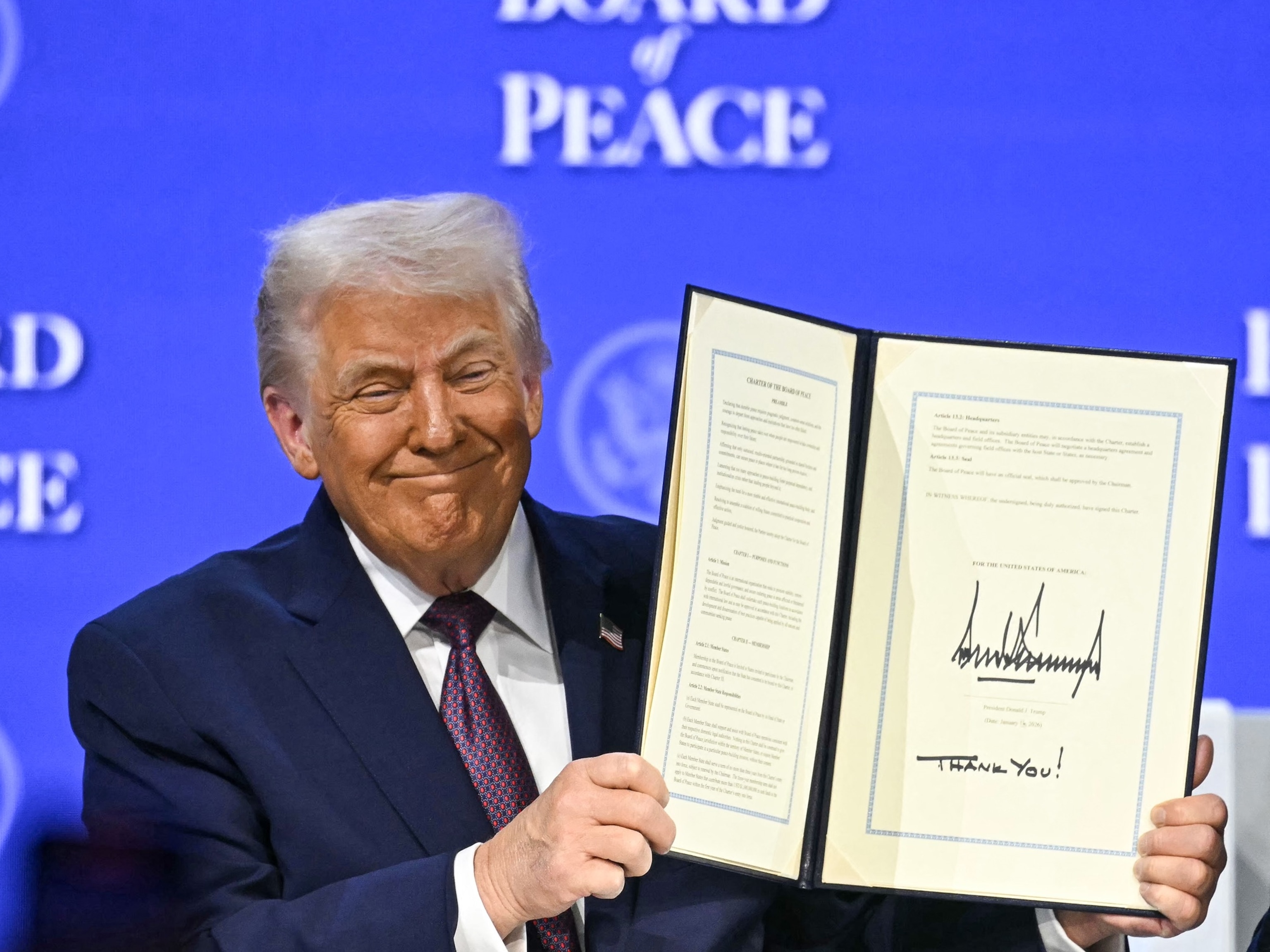
Trump unveiled the Board of Peace as what he called "one of the most consequential bodies ever created." The concept is straightforward: a Trump-chaired organization that can "do pretty much whatever we want to do," in his own words, starting with Gaza reconstruction but potentially expanding to resolve conflicts worldwide.
The price of admission? Three-year memberships are available, but permanent seats cost $1 billion. Trump gets to decide who joins. Trump is chair for life. The 11-page charter names exactly one person by name: "Chairman Trump." As of this afternoon, roughly 25 countries have signed on: UAE, Hungary, Argentina, Egypt, Israel, Kazakhstan, Belarus, Morocco, Pakistan, Saudi Arabia, Turkey, and others. Notably absent: Germany, France, the UK, Italy, Canada (despite initially signaling interest), and pretty much every major Western European ally. Secretary of State Marco Rubio called it "a board of action" with "endless" possibilities. Jared Kushner displayed architectural renderings of a rebuilt Gaza coastline with high-rises and tourism zones, what he called "New Gaza."The Dutch Connection
Here's where it gets interesting for those of us watching from The Hague: Sigrid Kaag, former Dutch Deputy Prime Minister and Finance Minister, sits on the Gaza Executive Board that will implement the Board of Peace's vision on the ground.
This is the same Sigrid Kaag who served as UN Special Coordinator for the Middle East Peace Process until recently. The same Kaag who led the mission to destroy Syria's chemical weapons. The same Kaag who represented everything the traditional multilateral system stands for. Her presence on a Trump-led body is... let's say, unexpected. The Netherlands itself hasn't joined as a member country, but having a former Dutch Deputy PM on the executive board creates an awkward situation for the new D66-VVD-CDA government, which has been trying to maintain distance from Trump's more controversial initiatives.What Europe Said (And Didn't Say)
The silence from Brussels has been deafening. Germany's Foreign Ministry reportedly circulated a document declining the invitation. France said no. The UK stayed away. Norway's state secretary said the proposal "raises a number of questions." Slovenia's PM called it something that "dangerously interferes with the broader international order."
Belgium provided perhaps the most awkward moment of the day: the White House initially listed them as a signatory, only for Deputy PM Maxime Prévot to post on X that Belgium had "NOT signed" and that the announcement was "incorrect." Meanwhile, the EU's own position remains unclear. Von der Leyen was in Davos but wasn't present at the signing. The invitation went to "the European Union's executive arm", whatever that means in practice.Why This Matters
Let me be direct about what we're watching: the creation of a parallel international system where the United States, under Trump, serves as permanent chairman with veto power over everything.
The UN Security Council has five permanent members with vetoes. The Board of Peace has one: Trump. The UN has 193 member states that each get a vote. The Board of Peace has membership by invitation only, with the chairman deciding who gets in. Trump has been explicit about his intentions. "The United Nations never helped me," he said. "This board might replace the UN." He's not hiding the ball. For European foreign policy, this creates an impossible choice. Join and legitimize a body designed to circumvent the multilateral system you've spent 80 years building. Or stay out and risk being excluded from decisions about Gaza, Ukraine, and whatever else Trump decides the Board should handle. The countries that joined the signing ceremony today made their choice. The countries that didn't are betting that this either won't last or won't matter. We're about to find out who's right.The Gaza Question
Lost in the spectacle is what this actually means for Palestinians. The Board of Peace charter doesn't mention Gaza once. Kushner's presentation showed gleaming towers and tourism zones, not a path to statehood, not a political solution, not self-determination.
Al Jazeera's reporter on the ground captured the mood: "Palestinians felt that turning a new chapter does not sound as easy as the Americans think." They're being "discussed as a problem to be managed, not as people with rights to be fully addressed." That's a damning assessment, and one that European governments will have to reckon with if they eventually decide to engage with this body.What Comes Next
Trump meets Putin's envoy later today. Zelenskyy met Trump in Davos this morning, with Trump telling reporters "this war has to end." The first US-Russia-Ukraine trilateral talks are apparently being scheduled.
If Trump can deliver on Ukraine, even a flawed deal, the Board of Peace suddenly looks like a success. If he can't, it looks like an expensive vanity project. Either way, the multilateral order just got more complicated. The UN isn't going anywhere, but it now has a competitor backed by the world's largest economy and chaired by a man who sees international institutions as obstacles rather than tools. For those of us who studied European integration and believed in the multilateral project, today was a sobering reminder: the system we thought was permanent is actually quite fragile. And we're watching, in real time, what happens when the country that built that system decides it would rather build something else.Watching today's events from The Hague, I couldn't help but think about how different this looks from the EU perspective versus the American one. What's your take, is the Board of Peace a genuine alternative to the UN, or a temporary phenomenon that won't outlast the Trump presidency?.
Share this article
Mr. Squorum
Political Analyst
Political analyst specializing in Dutch-EU relations and European affairs.
Related Articles
The Pause That Wasn't: Ukraine's Energy Ceasefire Expires as Temperatures Hit -26°C
A week-long pause in Russian attacks on Ukraine's energy infrastructure expired on February 1 with no extension in sight. With millions facing Arctic cold and the Abu Dhabi diplomatic track stalling, the fragile arrangement highlights the gap between announcements and reality.
5 min read
Trump's Board of Peace: The Improbable Coalition Tasked with Rebuilding Gaza
With the last hostage returned to Israel, the U.S.-brokered ceasefire enters its second phase. The question now is whether an ad-hoc group of nations can succeed where decades of diplomacy have failed.
6 min readComments (0)
Loading comments...