Germany's 2026 Stress Test: Can the Firewall Against the Far Right Hold?
Five state elections. One fragile federal coalition. And a far-right party polling at 40% in parts of the country. This is the year Germany finds out if its political system still works.
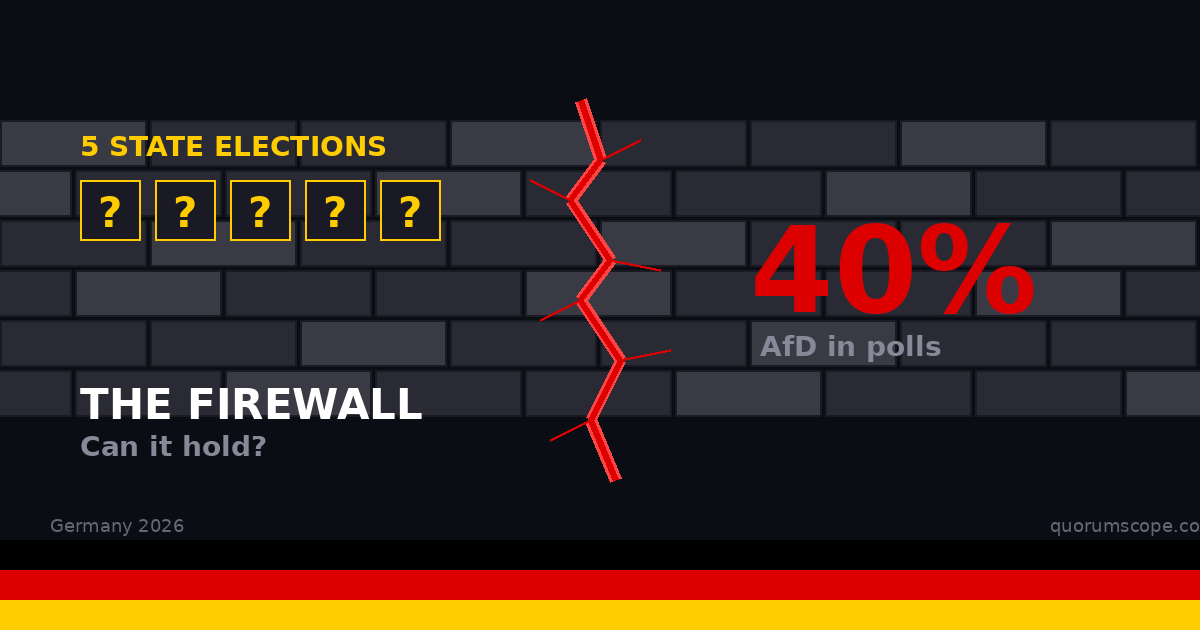
This is the year Germany finds out if its political system still works.
Five state elections. One fragile federal coalition. And a far-right party polling at 40% in parts of the country.
I've been watching European politics long enough to know that Germany doesn't do drama. It does stability. Consensus. Boring competence. That's been the formula since 1949.
But 2026 might break the formula.
The Setup
Let's start with what we know.
In February 2025, Germany held federal elections. Friedrich Merz's CDU/CSU won with 28.5%, not great, but enough. The far-right Alternative für Deutschland (AfD) surged to second place with 20.8%, their best result ever. The SPD collapsed to 16.4%, their worst showing in over a century.
The result: a "grand coalition" between CDU/CSU and SPD. On paper, they have 328 of 630 seats, a workable majority. In practice, it's the smallest "grand coalition" in German history. The era of big tent parties commanding 35-40% of the vote is over.
Merz became Chancellor in May 2025. His coalition is already under strain. Only about a third of Germans think it will survive until the next federal election in 2029.
And now comes the stress test.
Five Elections, One Question
Germany holds five state elections this year:
March 8: Baden-Württemberg (southwest)
March 22: Rhineland-Palatinate (west)
September 20: Berlin
September: Saxony-Anhalt (east)
September: Mecklenburg-Western Pomerania (northeast)
The March elections in the west will probably see the CDU take over from the Greens and SPD respectively. That's normal political turnover. Nothing dramatic.
September is where it gets interesting.
In Saxony-Anhalt, the AfD is polling at 40%. Forty percent. In a multiparty system where smaller parties often fail to clear the 5% threshold, that could translate into an outright majority of seats.
If that happens, the AfD would lead a state government for the first time in German history.
The polls in Mecklenburg-Western Pomerania tell a similar story, AfD at 38%, way ahead of everyone else.
The Firewall Problem
Since 2013, Germany's mainstream parties have maintained what they call a "firewall" or "cordon sanitaire" against the AfD. No cooperation. No coalitions. No votes together. Complete isolation.
The logic was simple: treat them as illegitimate and eventually they'll go away.
It didn't work.
The AfD has grown in every single federal election. The domestic intelligence agency (BfV) now classifies them as a "suspected right-wing extremist organization." There are calls to ban them entirely. And yet they keep gaining support.
Now the firewall faces its ultimate test.
If the AfD wins 40% in Saxony-Anhalt but falls just short of a majority, the other parties have two options:
Option 1: Form an anti-AfD coalition of everyone else, CDU, SPD, Die Linke, maybe the Greens. This would require the CDU to break its own "incompatibility resolution" against working with Die Linke, the successor to East Germany's socialist party.
Option 2: Let the AfD try to form a minority government, or accept some form of cooperation.
Neither option is good.
A grand coalition-plus-Die Linke arrangement would look exactly like what AfD voters have been complaining about: all the "establishment" parties ganging up to deny the democratic choice of voters. It would probably fuel AfD support even further.
But any cooperation with the AfD would shatter the firewall that's been holding since the party's founding. Once you cross that line, you can't uncross it.
What the AfD Actually Wants
Here's what makes this particularly combustible.
The AfD isn't just campaigning on immigration anymore. Their program now includes: withdrawal from the EU. Withdrawal from NATO. Recognition of Russian annexation of Crimea. Ending sanctions against Russia. Dismantling Germany's renewable energy transition.
These aren't fringe positions within the party, they're official policy. The AfD's co-leader, Alice Weidel, recently called for a "Dexit" referendum.
An AfD state government couldn't implement any of this, of course. Foreign policy is federal. But they could obstruct federal policy through the Bundesrat (the upper house where states are represented). They could appoint judges sympathetic to their worldview. They could reshape education policy. They could make governance difficult in ways large and small.
More importantly, an AfD government would be a proof of concept. If they can govern a state without the sky falling, the argument for the firewall weakens considerably.
The Bigger Picture
I think what we're seeing in Germany isn't unique, it's a particularly German version of a pattern playing out across Europe.
Mainstream parties spent decades converging toward a technocratic center. Immigration was managed by bureaucrats, not debated by politicians. Voters who had concerns were told those concerns were illegitimate. The political system worked well for people who were comfortable with the status quo.
Then the status quo stopped working for a lot of people. Economic stagnation. Housing crises. Cultural anxiety. And suddenly there was a market for parties willing to say what the mainstream wouldn't.
The AfD filled that market in Germany. Now they're testing whether the system can absorb them, co-opt them, or exclude them.
Saxony-Anhalt has the lowest GDP per capita of any German state. It's lost population steadily since reunification. It's the kind of place where abstract talk about "European values" doesn't pay the bills.
What Happens Next
Here's my honest assessment.
The AfD will probably finish first in Saxony-Anhalt and Mecklenburg-Western Pomerania. Whether they get an outright majority depends on turnout, on whether smaller parties clear 5%, and on how much the mainstream parties can mobilize.
If they win a majority: Germany enters uncharted territory. A far-right party will govern a state for the first time since 1945. The implications for the federal coalition, for EU politics, for Germany's international standing - all unknown.
If they fall short: expect months of messy coalition negotiations. The mainstream parties will probably cobble together some anti-AfD arrangement. It will look illegitimate to 40% of voters. The AfD will spend the next three years campaigning against it.
Either way, the firewall is cracking. Maybe not this year, maybe not this election cycle. But the strategy of isolation and exclusion has failed to stop the AfD's rise. At some point, Germany's political establishment will have to try something else.
The question is whether they figure out what that is before the AfD figures out how to govern.
Share this article
Mr. Squorum
Political Analyst
Political analyst specializing in Dutch-EU relations and European affairs.
Related Articles

German-Turkish Director Ilker Catak Wins Golden Bear at Berlinale for Political Drama Yellow Letters
The 76th Berlin Film Festival concludes with politically charged ceremony as Yellow Letters takes top prize and Sandra Huller wins Best Performance for Rose.
4 min read
Slovakia Threatens to Cut Electricity Supply to Ukraine as Fico Escalates Energy Dispute
Slovak Prime Minister announces plans to halt electricity transmission to Ukraine from Monday, escalating tensions with Kyiv over energy transit issues.
4 min readComments (0)
Loading comments...