Europe's Nuclear Option: Could the Netherlands Weaponize ASML Against Washington?
A Dutch think tank proposes the unthinkable: using chip technology as leverage against America. It reveals both Europe's growing frustration and its limited options.
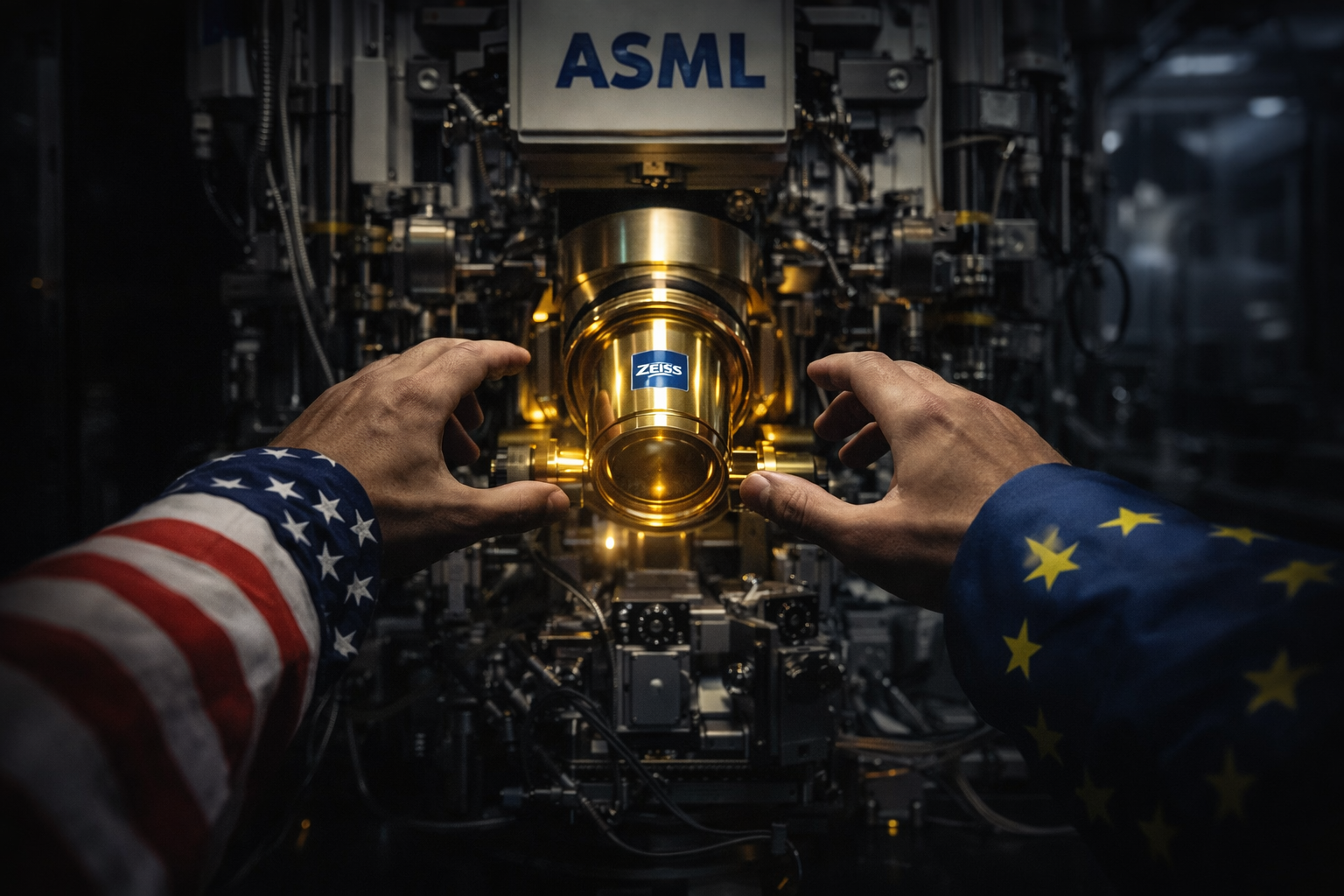
For years, the United States has pressured the Netherlands to restrict ASML's exports to China. Washington has treated Dutch chip technology as a strategic asset to be denied to adversaries, with the Netherlands expected to comply. And comply it has, repeatedly tightening export controls at American insistence.
Now, a provocative report from Dutch think tank DenkWerk suggests Europe should consider pointing that same weapon in a different direction: toward Washington itself.
The idea is as audacious as it is revealing. It signals that transatlantic tensions have reached a point where even loyal allies are contemplating economic warfare against the United States. Whether such a move is realistic, or wise, is another question entirely.
The Veldhoven Chokepoint
ASML, headquartered in Veldhoven, is not just another tech company. It is the sole manufacturer of extreme ultraviolet (EUV) lithography machines, the €170-200 million devices that print the circuits on cutting-edge semiconductors. Without ASML equipment, no one makes advanced chips. Not Intel, not TSMC, not Samsung. Certainly not China.
This monopoly gives ASML extraordinary strategic significance. Control access to its machines, and you control who can participate in the semiconductor industry. The company holds roughly 90% of the EUV market, with no meaningful competition in sight. Its order backlog stretches over two years.
The United States recognized this leverage early. Beginning in 2019, the Trump administration pressured the Dutch government to block EUV sales to China. The Biden administration expanded those restrictions to include older deep ultraviolet (DUV) systems. The Netherlands complied, despite significant costs to ASML's business. China had become one of its largest markets.
The DenkWerk Proposal
Against this backdrop, the DenkWerk report reads like a thought experiment in role reversal. If the Netherlands has been willing to weaponize ASML at America's request, why not consider wielding that weapon independently?
The think tank suggests that ASML technology could serve as "leverage" in negotiations with Washington, particularly regarding trade disputes, tariff threats, and the broader question of European autonomy. In essence: if America threatens Europe with economic coercion, Europe could threaten to redirect chip technology toward alternative partners.
The proposal reflects genuine frustration. Under both Trump administrations, the United States has treated European allies less as partners than as subordinates, expected to absorb costs without question. Tariff threats, sanctions extraterritoriality, and pressure on technology exports have accumulated into what many Europeans perceive as economic bullying.
The Limits of Leverage
Yet the proposal also illustrates the constraints on European action. ASML may be Dutch, but it is deeply embedded in global supply chains that depend heavily on American components and intellectual property. Its machines contain American technology, and are therefore subject to American export controls.
Moreover, threatening to cut off American chipmakers would likely prove self-defeating. The United States remains a critical market for European goods, and economic warfare with Washington would carry enormous costs. The asymmetry of power means that Europe would likely lose any such confrontation.
There is also the question of alliance politics. Whatever their frustrations, European governments remain committed to the transatlantic relationship as the cornerstone of their security. Breaking with Washington over semiconductors would raise fundamental questions about NATO solidarity and the broader Western alliance.
A Signal, Not a Strategy
The DenkWerk proposal is best understood not as a realistic policy option but as a signal of European sentiment. It reflects the depth of frustration with American conduct and the growing desire for European strategic autonomy.
That desire is real, even if the means to achieve it remain elusive. Europe lacks the scale, the technological base, and the political cohesion to stand alone against either the United States or China. It can nibble at the edges of dependence, but it cannot escape it.
What Europe can do is raise the costs of American coercion, making clear that treating allies as vassals carries political consequences. The ASML debate, however theoretical, serves that purpose. It puts Washington on notice that European patience has limits.
The Deeper Question
Ultimately, the question is not whether Europe will weaponize ASML against America. It almost certainly will not. The question is what kind of transatlantic relationship will emerge from this period of strain.
If Washington continues to treat Europe as a junior partner to be disciplined, it risks accelerating European efforts to reduce dependence, even at significant cost. If it recognizes that durable alliances require mutual respect, it may find that Europe remains its most valuable strategic asset.
The DenkWerk proposal, provocative as it is, highlights a truth that American policymakers would do well to remember: leverage works both ways. The Netherlands may be small, but in the architecture of global technology, it holds a key position. How that position is used will depend on how the Dutch, and Europeans more broadly, are treated by their most important ally.
"In the new landscape of techno-nationalism, the Netherlands finds itself holding cards it never expected to play."
Share this article
Mr. Squorum
Political Analyst
Political analyst specializing in Dutch-EU relations and European affairs.
Related Articles

The Art of the Framework: How Mark Rutte Sold Trump a Deal That Doesn't Exist
NATO's Secretary General managed to talk the American president out of trade war with Europe by offering him something called a 'framework.' Nobody is quite sure what that means, which appears to be the point.
7 min read
Sell America: Europe's Trump Card in the Transatlantic Trade War
As Trump threatens allies over Greenland, Europe quietly counts its financial weapons, including $10 trillion in Treasury bonds and a never-used "bazooka."
9 min readComments (0)
Loading comments...