Sell America: Europe's Trump Card in the Transatlantic Trade War
As Trump threatens allies over Greenland, Europe quietly counts its financial weapons, including $10 trillion in Treasury bonds and a never-used "bazooka."
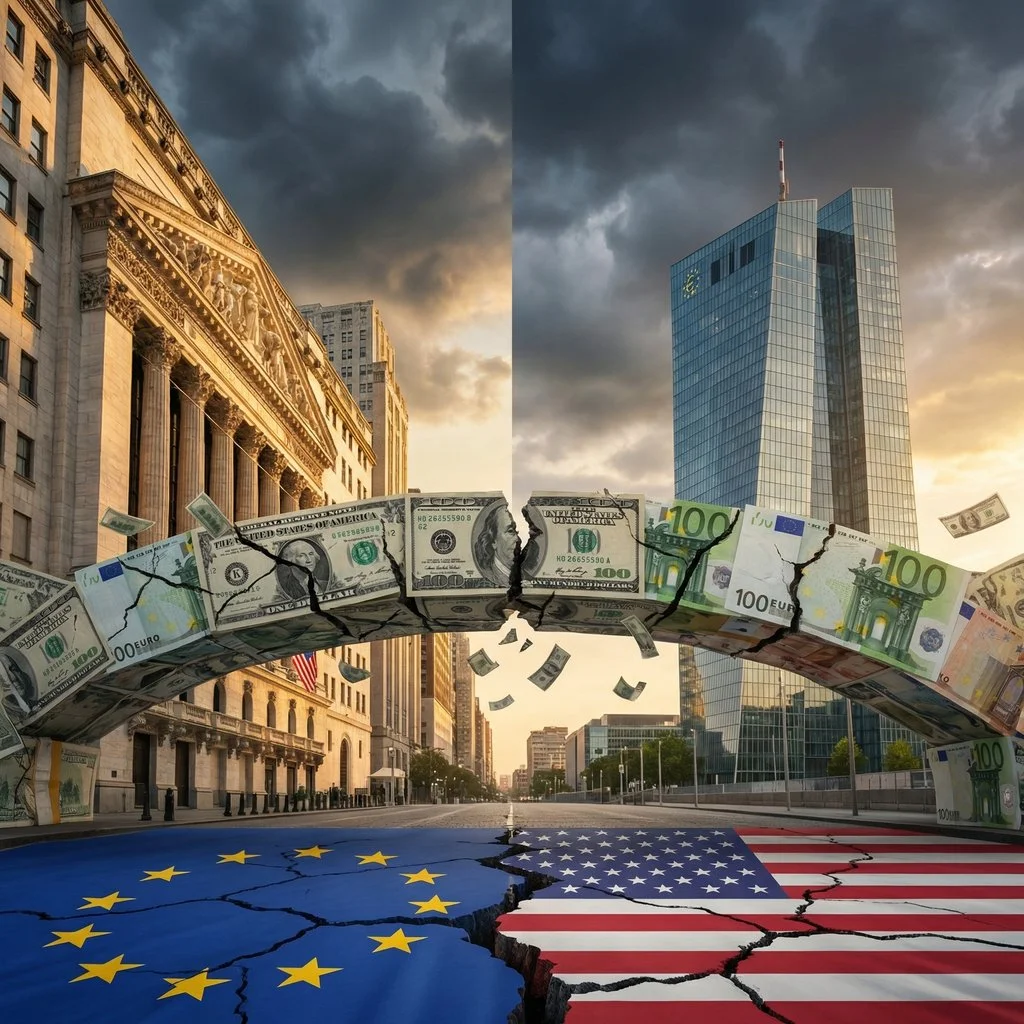
The phrase "mutually assured destruction" was coined during the Cold War to describe nuclear deterrence. In 2026, it might be more accurately applied to the transatlantic financial relationship, where Europe holds enough American debt to cause genuine chaos, if only it were willing to shoot itself in the foot to wound its ally.
"Sell America", two words that have sent tremors through trading floors from Wall Street to Frankfurt. The concept is simple: European investors hold over $10 trillion in US Treasury bonds. If they were to dump these assets en masse, the resulting flood would crater bond prices, spike American borrowing costs, and potentially trigger a financial crisis that would make 2008 look like a minor correction. It is, in the parlance of financial warfare, the nuclear option.
The fact that this option is now being discussed openly tells you everything you need to know about the current state of transatlantic relations. When Emmanuel Macron stood at the World Economic Forum in Davos last week and spoke approvingly of deploying the EU's "trade bazooka," he was not engaging in hyperbole. He was describing a genuine policy instrument that Brussels has had locked away since 2023, waiting for precisely this kind of moment.
- Krishna Guha, Evercore ISI
The Bazooka in the Room
The Anti-Coercion Instrument, the official name for Macron's bazooka, was adopted by the EU in 2023 following China's economic pressure on Lithuania. It has never been used. The instrument allows the bloc to ban foreign firms from European government contracts, restrict access to EU markets, limit foreign direct investment, and suspend intellectual property payments. Applied to the United States, it could inflict billions in costs on American companies.
But here's the catch: deploying the ACI would take at least six months. It requires agreement from at least 15 EU member states representing 65 percent of the bloc's population. It demands a formal investigation process. By the time Brussels finished filling out the paperwork, Trump could have moved on to threatening to annex the Moon.
More fundamentally, the bazooka suffers from a credibility problem. It's designed to punish economic coercion, but using it would inflict considerable damage on European economies that are deeply intertwined with American markets. EU-US trade in goods and services amounted to €1.7 trillion in 2024, roughly €4.6 billion every single day. That's not a relationship you disrupt lightly.
EUROPE'S FINANCIAL ARSENAL
- US Treasury holdings: $10+ trillion across European investors
- Top holders: UK ($865B), Belgium ($466B), Luxembourg ($421B), France ($376B), Ireland ($340B)
- Anti-Coercion Instrument: Never used, 6+ months to deploy
- Retaliatory tariffs: €93 billion package frozen since summer 2025
- Daily trade volume: €4.6 billion in goods and services
The Quiet Exodus
While politicians debate the merits of financial warfare, something more subtle is already happening. European pension funds, those vast pools of retirement savings that form the bedrock of the continent's investment landscape, have been quietly reducing their exposure to American government debt. Not with dramatic announcements, but through the steady, methodical process of portfolio reallocation.
The Dutch Connection
The most striking example comes from ABP, the Netherlands' largest pension fund with €538 billion in assets. At the end of March 2025, ABP held €29 billion in US Treasury bonds. By September, that figure had dropped to €18.6 billion, a reduction of more than €10 billion in just six months. The timing is notable: this exodus began precisely when Trump reimposed his global tariffs.
ABP declined to explain its reasoning, but investment advisor Pim Zomerdijk of Sprenkels offered a diplomatic translation: "Trump's unpredictability, and more broadly the increasing geopolitical uncertainty, are leading pension funds to examine their financial and non-financial resilience more critically than before." In the same period, ABP increased its holdings of Dutch and German government bonds by €9 billion combined. The money didn't disappear, it simply went somewhere safer.
Danish pension funds have made similar moves, with some explicitly citing Trump's Greenland threats as the motivation. A Greenlandic pension fund announced it would divest from American assets entirely, a gesture that carries more symbolic weight than financial impact, but symbolism matters in these disputes.
The Asymmetry Problem
The fundamental challenge Europe faces is what analysts call "mutual but asymmetric dependence." Yes, American companies need European markets. Yes, the US government relies on foreign buyers for its debt. But Europe's dependence on America is operational, technological, and security-critical in ways that go far beyond commerce.
Consider the numbers: if European investors were to dump Treasury bonds aggressively, bond yields would spike, meaning higher mortgage rates and borrowing costs for American consumers. But the same selling pressure would crater the value of Europe's remaining holdings. France, already struggling with a growing deficit and no budget in sight, would watch billions in "safe" assets evaporate. The cure might be worse than the disease.
Moreover, there's nowhere obvious for that money to go. The US Treasury market exists at its scale precisely because no alternative offers the same combination of liquidity, safety, and depth. European bonds? German Bunds are solid but the market is smaller. Chinese government debt? Please. The irony is that European investors hold American debt partly because there's nothing better, and Trump knows it.
Financial Chicken
What we're witnessing is an elaborate game of financial chicken, where both sides possess weapons capable of causing tremendous damage but neither can use them without hurting themselves. The "Sell America" trade briefly materialized last week when Trump's Greenland tariff threats triggered a simultaneous selloff in US stocks, bonds, and the dollar, the classic sign of investors fleeing American assets. Markets lost $1.2 trillion in a single day.
But here's what happened next: within days, Trump announced a mysterious "framework" deal with NATO Secretary General Mark Rutte, dropped his tariff threats, and markets recovered. The bazooka remained holstered. The Treasuries remained mostly unsold. Everyone went back to pretending the transatlantic alliance was fine.
The real message of the past week isn't that Europe has powerful financial weapons, it clearly does. The message is that having weapons and being willing to use them are very different things. Europe can theoretically inflict serious damage on the American economy. But doing so would require a level of coordination, resolve, and tolerance for self-harm that the EU has never demonstrated.
In the meantime, the quiet exodus continues. Dutch pension funds shift their portfolios. Danish investors cite geopolitical concerns. The money flows, slowly but steadily, from American government debt to European alternatives. It's not a bazooka. It's not even a coordinated strategy. But it might be the most honest expression of European sentiment toward Trump's America: not war, not peace, just a gradual, prudent distancing. Sometimes the most powerful statement is simply walking away.
Share this article
Mr. Squorum
Political Analyst
Political analyst specializing in Dutch-EU relations and European affairs.
Related Articles

The Art of the Framework: How Mark Rutte Sold Trump a Deal That Doesn't Exist
NATO's Secretary General managed to talk the American president out of trade war with Europe by offering him something called a 'framework.' Nobody is quite sure what that means, which appears to be the point.
7 min read
Europe's Nuclear Option: Could the Netherlands Weaponize ASML Against Washington?
A Dutch think tank proposes the unthinkable: using chip technology as leverage against America. It reveals both Europe's growing frustration and its limited options.
4 min readComments (0)
Loading comments...