Minneapolis Burns, Europe Watches: When Immigration Enforcement Becomes Occupation
Two American citizens killed by federal agents in three weeks. 50,000 protesters in -29°C. A government shutdown looming. And in Leiden, Dutch academics ask: could this happen here?
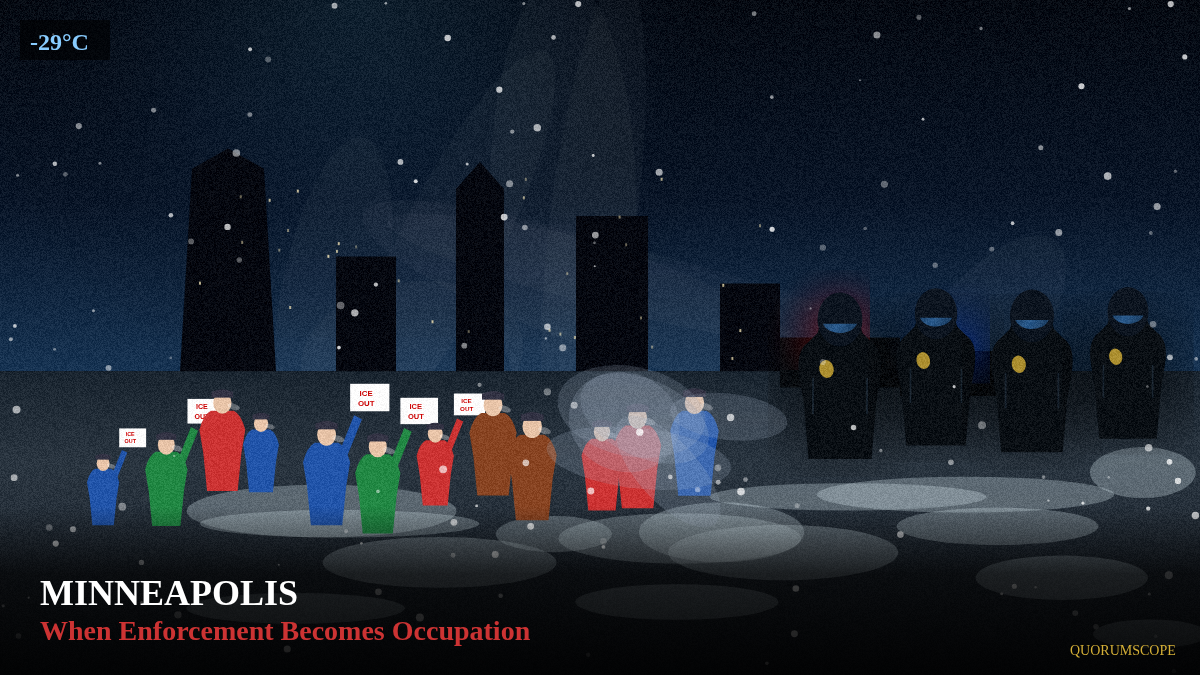
Alex Pretti was an ICU nurse. He worked at a Veterans Affairs hospital in Minneapolis, caring for the soldiers America sent to foreign wars. On Saturday morning, he was shot dead by a Border Patrol agent on a residential street in south Minneapolis. He was 37 years old, a US citizen, and according to bystander video, had his phone in his hand and his other arm raised when federal agents opened fire.
Eighteen days earlier, Renee Good, also 37, also a US citizen, was shot through the head by an Immigration and Customs Enforcement agent while driving her SUV. She was a mother of three. The Trump administration called her a "domestic terrorist" within minutes of her death.
Two American citizens. Zero immigration violations. Three weeks. Welcome to President Trump's largest immigration enforcement operation in American history.
The Occupation of Minneapolis
There is a word for what is happening in Minnesota, and it is not "enforcement." Governor Tim Walz used a different one on Saturday: "occupation."
"This long ago stopped being a matter of immigration enforcement," Walz said after Pretti's death. "It's a campaign of organised brutality against the people of our state."
The numbers are staggering. The Department of Homeland Security has deployed 3,000 federal agents to Minneapolis, a city of 430,000 people. That's roughly one federal agent for every 143 residents. By comparison, the city's entire police department has about 600 officers. The federal deployment is five times larger than the local force.
Since early January, ICE operations in Minnesota have arrested approximately 12,000 people, according to the Trump administration. Schools have closed. Businesses have shuttered. On Friday, an estimated 50,000 people marched through downtown Minneapolis in temperatures of minus 29 Celsius, the coldest protest in the city's history, demanding that federal agents leave.
One hundred clergy members were arrested at Minneapolis, Saint Paul International Airport after kneeling in prayer on the tarmac. Their crime: blocking access to charter flights deporting detainees to out-of-state facilities.
The Minneapolis Police Chief, Brian O'Hara, has been reduced to publishing guides helping residents distinguish between city employees and federal agents. "Nobody in a City uniform will ever ask for your immigration papers," the bulletin notes. The subtext is unmistakable: we cannot protect you from our own federal government.
The European Mirror
At Leiden University, Professor Maartje van der Woude has been fielding calls from journalists asking a question that would have seemed absurd a decade ago: could this happen in the Netherlands?
Van der Woude, an expert on border control in the Netherlands and EU, doesn't dismiss the comparison outright. "What we're seeing here is that political choices affect the daily practice of monitoring and checks," she told the university's news service. "Stepping up border controls under political pressure is never 'neutral.'"
The parallel is uncomfortable but real. The Netherlands has its own hard-right turn on migration policy. The government is negotiating with Uganda to establish a deportation processing centre in Africa, a policy that mirrors the Trump administration's use of third countries to bypass domestic legal protections.
Tim van Lit, a Leiden researcher who studies Dutch border enforcement, notes that the Royal Netherlands Marechaussee has significantly expanded its presence at internal borders. Under the Schengen Agreement, such checks are supposed to be exceptional. In practice, they have become routine.
"The question is not whether we have the legal architecture for something like Minneapolis," van Lit said. "It's whether we have the political will to prevent it."
The Government Shutdown Gambit
The Minneapolis crisis has now metastasised into a fiscal crisis. Congress faces a funding deadline this Friday, and Senate Democrats are refusing to vote for spending packages that include DHS funding. Senator Chuck Schumer has signalled his caucus will block the bill, raising the possibility of a partial government shutdown.
The irony is bitter. Immigration was supposed to be Trump's strongest issue. He won 2024 on mass deportation promises. But polls show his approval has collapsed: from an even split in March 2025 to 61% disapproval in mid-January. An ACLU poll found 84% of Americans believe people have the right to observe and record ICE activities, exactly what Alex Pretti was doing when he was killed.
What Europe Should Learn
The temptation for European observers is to treat Minneapolis as an American aberration, the product of gun culture, weak institutions, and a uniquely deranged political moment. This is comforting. It is also wrong.
The structural conditions that enable Minneapolis exist in Europe. The EU's Frontex agency operates with significant autonomy from national parliaments. Hungary's Viktor Orbán has deployed military forces to his borders for nearly a decade. Italy's government has criminalised humanitarian rescue operations in the Mediterranean.
This is the structural feature that makes Minneapolis possible: the divorce between local democratic accountability and federal enforcement power. ICE agents do not answer to Mayor Frey or Governor Walz. They answer to Trump. And Trump has accused local officials of "inciting insurrection" and threatened to invoke the Insurrection Act to deploy active-duty military.
The Cold Truth
On Friday, as 50,000 Minnesotans marched through the coldest weather in years, a protest sign captured the moment: "The North is stronger."
They were not just talking about the weather. They were talking about a wager: that sustained, peaceful resistance can outlast federal aggression. That local solidarity can protect neighbours when the federal government becomes the threat. That democratic norms, once broken, can be rebuilt.
Europeans may soon face the same wager. The question is whether they learn from Minneapolis before their own streets become occupied territory, or after.
Alex Pretti went to those protests because, his father said, "he thought it was terrible, kidnapping children, grabbing people off the street. He cared about those people, and he knew it was wrong."
He was right. He paid for being right with his life.
And somewhere in The Hague, in Brussels, in Berlin, officials are watching the footage and calculating: how far are we from this? The honest answer is closer than they think.
Share this article
Mr. Squorum
Political Analyst
Political analyst specializing in Dutch-EU relations and European affairs.
Related Articles

The Art of the Framework: How Mark Rutte Sold Trump a Deal That Doesn't Exist
NATO's Secretary General managed to talk the American president out of trade war with Europe by offering him something called a 'framework.' Nobody is quite sure what that means, which appears to be the point.
7 min read
Sell America: Europe's Trump Card in the Transatlantic Trade War
As Trump threatens allies over Greenland, Europe quietly counts its financial weapons, including $10 trillion in Treasury bonds and a never-used "bazooka."
9 min readComments (0)
Loading comments...