When "Trump's America" Becomes the Threat: What Dutch Opinion Polls Tell Us About the End of the Atlantic Era
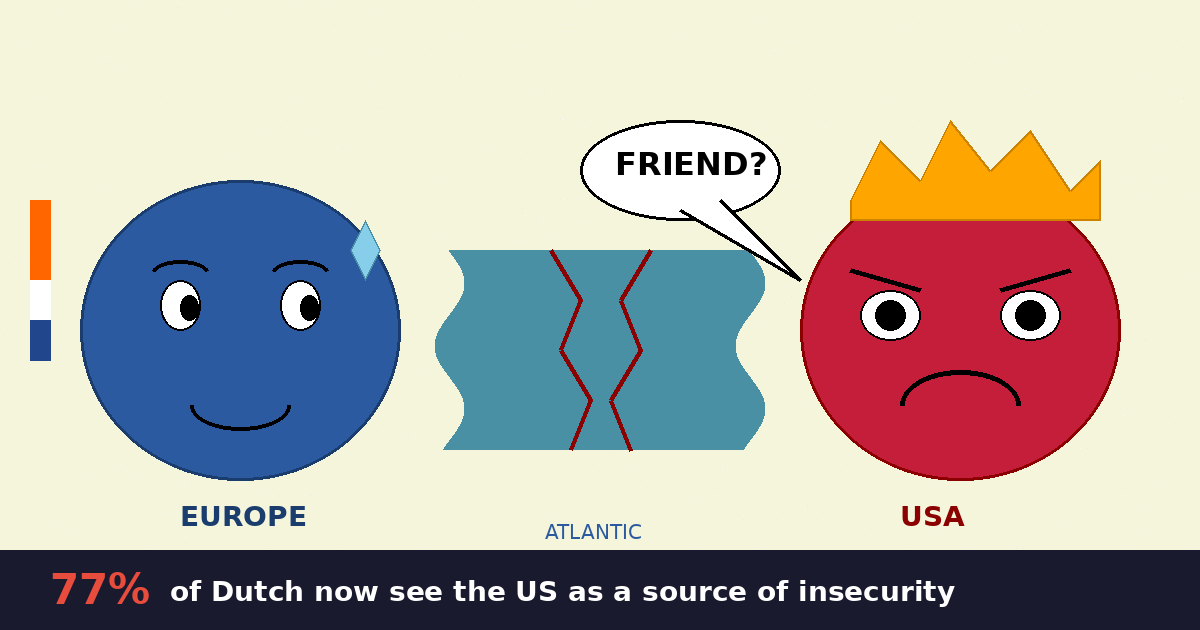
For the first time since 1945, more Dutch citizens name the United States as a threat to their security than Russia. Let that sink in. Eighty years of transatlantic partnership, and this is where we are.
I've been analyzing transatlantic relations for years. I studied at European universitites, where we were taught that NATO was the bedrock of European security, that Article 5 was sacred, that the American commitment to Europe was unshakeable.
This week, I read a poll that made me question everything I learned.
According to the Netherlands Atlantic Association, an organization literally founded in 1952 to promote Dutch-American friendship, 14% of Dutch respondents now spontaneously name "Trump's America" as the greatest threat to Dutch and European security.
Russia? 11%.
Read that again. The country that invaded Ukraine, that shot down MH17 over eastern Ukraine killing 196 Dutch citizens, that runs disinformation campaigns across Europe, that country is now considered less threatening than our own ally.
This isn't a fringe view. This is mainstream Dutch opinion. And it should terrify everyone in Brussels, The Hague, and yes, Washington.
The Numbers Are Brutal
The Transatlantic Security Opinion Poll 2026, conducted between January 1-8, before Trump's tariff threats over Greenland, paints a picture of complete collapse in Dutch trust.
Let me walk you through the damage:
77% of Dutch citizens now view the United States as a source of global insecurity. Not security. Insecurity.
81% say Europe can no longer count on unconditional American military support.
80% call Trump "unreliable." Another 80% call him "disruptive." 71% say he's "polarizing."
51% rate the current US-Europe relationship as "poor" or "very poor."
78% say Trump's first year back in office has had a primarily negative impact on transatlantic trade.
And here's the kicker: only 23% of Dutch people now consider the United States a stabilizing force in the world. In April 2025, it was 34%. In one year, American credibility has collapsed by a third.
Half of Dutch respondents expect the US to withdraw from NATO entirely.
Half.
The €135 Billion Question
Here's what makes this particularly painful for the Netherlands: we've been America's most loyal European ally for decades. Not rhetorically. Financially.
The "peace dividend", the money the Netherlands saved by relying on American defense instead of building its own military, amounts to an estimated €135 billion since World War II. That's not a typo. One hundred thirty-five billion euros.
In exchange, the Netherlands acquiesced to American priorities basically all the time. ASML export restrictions to China? Done, despite massive stock losses. NATO spending targets? Working on it. American military bases? Welcome.
Mark Rutte, our former Prime Minister and current NATO Secretary-General, practically built his diplomatic career on keeping Washington happy. Last week in Davos, he praised Trump as "the leader of the free world" doing "what I would love for a leader of the free world to do."
The Dutch public, apparently, disagrees.
What Changed This Week
The poll was conducted before the Greenland crisis escalated. Before Trump threatened 10% tariffs on the Netherlands and seven other European countries. Before Trump called Greenland, a NATO ally's territory, something he might take by force. Before Trump referred to NATO as a protection racket.
If 77% considered America a threat to global security before all that, I can only imagine what the next poll will show.
The EU summit last night in Brussels was supposed to discuss the "framework deal" Trump announced with Rutte on Greenland. Instead, it became an exercise in collective trauma processing.
European Council President António Costa was clear: "Only the Kingdom of Denmark and Greenland can decide on matters concerning Denmark and Greenland." Translation: we're not negotiating sovereignty with anyone, least of all an ally who threatens us.
The EU-US trade deal? Frozen by the European Parliament earlier this week. Now it's being "unfrozen", but the damage is done. Every European businessperson now knows that any agreement with Washington is only as good as Trump's next Truth Social post.
The European Army Question
What's remarkable is how quickly Dutch opinion is shifting on alternatives.
Support for a European army is rising across the continent. A Le Grand Continent survey found 71% of Europeans believe the EU should buy military equipment from member states rather than the US. Even in traditionally Atlanticist countries like the Netherlands and Poland, this view now has clear majority support.
The Dutch, specifically, increasingly want their government to take a tougher stance on Trump. They want stronger European defense cooperation. They want less dependence on an ally that behaves like an adversary.
And yet, and this is the frustrating part, only 13% of Dutch respondents believe Europe is well-prepared for a future without American protection.
We know we can't rely on America. We just haven't figured out how to rely on ourselves.
The View from The Hague
Working at a diplomatic mission, I see both sides of this collapse in real time. Official government statements remain carefully calibrated, "we value the transatlantic relationship," "dialogue is essential," "we're working toward mutual understanding."
But the private conversations are different. Dutch officials are genuinely unsure what American commitments mean anymore. Is Article 5 still credible? Would the US really defend Estonia? Poland? The Netherlands itself?
These aren't abstract questions. Russia is testing NATO's eastern flank daily. The Arctic is becoming a strategic flashpoint. China is watching everything.
And America's closest allies in Europe are now more afraid of Washington than Moscow.
What Happens Next
The trilateral talks between the US, Russia and Ukraine begin tomorrow in Abu Dhabi. Europe isn't at the table. Zelenskyy spent his Davos speech yesterday accusing Europe of being "lost", and he's right.
The EU will announce an investment package for Greenland. Von der Leyen talked about buying a European icebreaker. Denmark will insist on sovereignty red lines. Everyone will express "concern" and "vigilance."
None of this addresses the fundamental question: what do you do when your ally of 80 years becomes the threat?
The Dutch public has given their answer. They no longer trust America. They want Europe to stand on its own. They're ready for something different.
The question is whether their leaders, our leaders, have the courage to build it.
I keep thinking about those numbers: 14% name Trump's America as the greatest threat, 11% name Russia. My professors at my old University would have called this unthinkable. But we're not in that world anymore. The Atlantic era, as we knew it, is over. The only question is what comes next, and whether Europe will be ready for it.
Share this article
Mr. Squorum
Political Analyst
Political analyst specializing in Dutch-EU relations and European affairs.
Related Articles

The Art of the Framework: How Mark Rutte Sold Trump a Deal That Doesn't Exist
NATO's Secretary General managed to talk the American president out of trade war with Europe by offering him something called a 'framework.' Nobody is quite sure what that means, which appears to be the point.
7 min read
Sell America: Europe's Trump Card in the Transatlantic Trade War
As Trump threatens allies over Greenland, Europe quietly counts its financial weapons, including $10 trillion in Treasury bonds and a never-used "bazooka."
9 min readComments (0)
Loading comments...